For Delta Electronics, sustainability is much more than a slogan – it’s a core of its corporate mission, “To Provide Innovative, Clean, and Energy-efficient Solutions for a Better Tomorrow”. The Taiwan-based company has focused on energy conservation since its establishment in 1971. Back then, Delta built components for cathode ray tube TVs. As the global IT industry required more energy-efficient power supplies, Delta –always staying a step ahead– focused on the development of switching power supplies. Today, the company is a global leader in power and thermal management solutions, with a thriving solutions portfolio for AI data center infrastructure, smart energy microgrids, EV charging, smart manufacturing, building automation, telecom power and more – key technologies that are central to the global energy transition and digitalization.
That path of progress brought Delta to the Netherlands in 2000. Fast-forward a quarter century, and the company’s Dutch footprint has grown to an impressive scale with multiple locations and hundreds of employees. In 2025, Delta celebrated a major milestone with the groundbreaking of its new, state-of-the-art EMEA headquarters in the city of Hoofddorp – where it first began its Dutch journey.
For 25 years and counting, the Netherlands has played an integral part in Delta’s efforts to push the limits of what’s possible in high-tech systems and clean energy while investing in global talent and community. It is a story that reveals how forward-looking companies from around the world can elevate their impact when they partner with the Dutch ecosystem and leverage its strengths in innovation, sustainability and international connectivity.
Staying ahead in technology and research
To strengthen its innovation edge, Delta commonly invests over 8% of its annual revenues in R&D. The company has built a global innovation network with over 70 R&D centers worldwide, employing more than 12,000 R&D engineers and with over 18,000 approved patents as of 2024. Some of Delta’s solutions boast energy efficiency as high as 99%. In 2025, Delta’s server power supplies for AI data centers were the world’s first to obtain the 80PLUS Ruby certification, offering up to 97.5% energy efficiency. Moreover, the company has become an essential partner for the world’s leaders in AI data center technology due to its unique capability to provide energy-saving solutions for every stage between the electricity grid and the GPU/CPU accelerators. All this makes Delta an excellent fit for the Dutch innovation ecosystem and a strong contributor to Europe’s digital and energy transitions.
“Once we get to a milestone, we make sure that we keep that milestone with us,” explains Dalip Sharma, President and General Manager of Delta EMEA. “And keeping the milestone doesn’t just mean the number of units you ship out. Keeping a milestone means you always stay ahead in terms of technology research. As a market leader, it becomes a responsibility to keep pushing the technology forward.”
Why Delta continues to invest in the Netherlands
The strategic factors that first drew Delta to the Netherlands in 2000 are the same ones that encourage it to stay rooted in the country as a central hub for its EMEA business. “The Netherlands is a gateway to Europe, with very good connectivity all across Europe, the Middle East and Africa,” says Sharma. “Amsterdam Airport Schiphol is just a few minutes away. The Netherlands has the largest port in Europe – Rotterdam – so all our goods can move through here. The accessibility to our customers is excellent. When you look at the infrastructure in the Netherlands, it’s excellent and keeps getting better.”
And it’s not just infrastructure. “The Dutch emphasis on innovation, on clean and renewable energies makes a difference,” he adds. “There is a robust university ecosystem that we can access in this country. There is good talent availability here – and it is multicultural talent with expertise in different domains.”
These advantages propelled Delta to set up two main locations in the Netherlands: its EMEA headquarters in Hoofddorp managing regional operations since 2000, and a center in Helmond focused on industrial automation and automotive applications. The company has also established distribution hubs in cities like Rotterdam, Venlo and Eindhoven, facilitating efficient logistics and customer access across borders.
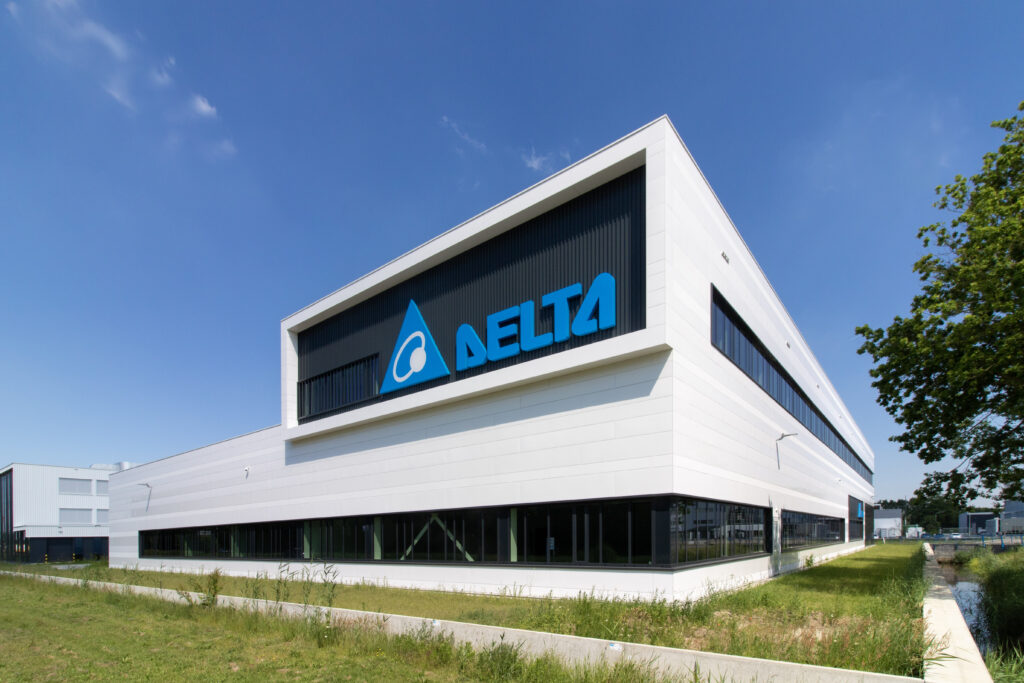
Delta EMEA’s green sales and R&D building in Helmond, the Netherlands.
As its global business grew in recent years, Delta needed to expand and modernize its EMEA headquarters to keep pace and accelerate R&D. For Sharma, the decision to stay in Hoofddorp was an easy one. “Hoofddorp has proven to be an excellent location for our growth over the past 25 years,” he notes. “It offers everything we need to serve customers across EMEA effectively.” Ultimately Delta chose to build its new headquarters at Park 20|20, a nearby business park in the city with an ethos of sustainability and circularity that aligns with the company’s mission.
A “perfect ecosystem” supporting open innovation
Sharma highlights the openness, transparency and collaborative ethos of the Dutch business landscape as a vital deciding factor for expansion: “We love the Dutch way of doing business and their way of life. It is well known that the Dutch are direct communicators who speak their minds. This candor cultivates a transparent, open and highly collaborative environment.”
That spirit makes a difference in the sectors where Delta operates. “The Netherlands as a country has a very high focus on research, on technology, on innovation. That is why you see a high density of companies developing cutting-edge technology,” he says. “The country also has a very high focus on clean energy, on the energy transition, on electrification. Amsterdam is one of the largest hubs in Europe for data infrastructure. All of these are domains that Delta is very active in. This alignment enables Delta to collaborate more deeply on innovations that support smart factories, AI-ready data centers and low-carbon energy systems.”
In turn, industry players like Delta draw support from the government and university ecosystem through the Dutch triple helix model of collaboration: “The Netherlands gives us more than market access; it gives us an opportunity to innovate, learn from and engage with other entrepreneurs, universities, the government and so on. It’s a perfect ecosystem for us to grow in; to learn as well as display some of our own technologies.”
Sharma attributes special value to government support. The Netherlands Foreign Investment Agency, regional partner Amsterdam Trade & Invest and the municipality of Haarlemmermeer have stood as steadfast partners to Delta throughout its journey of growth. By interacting regularly with national and local government partners, Sharma and his team gain a platform for direct problem-solving, consultation and assistance.
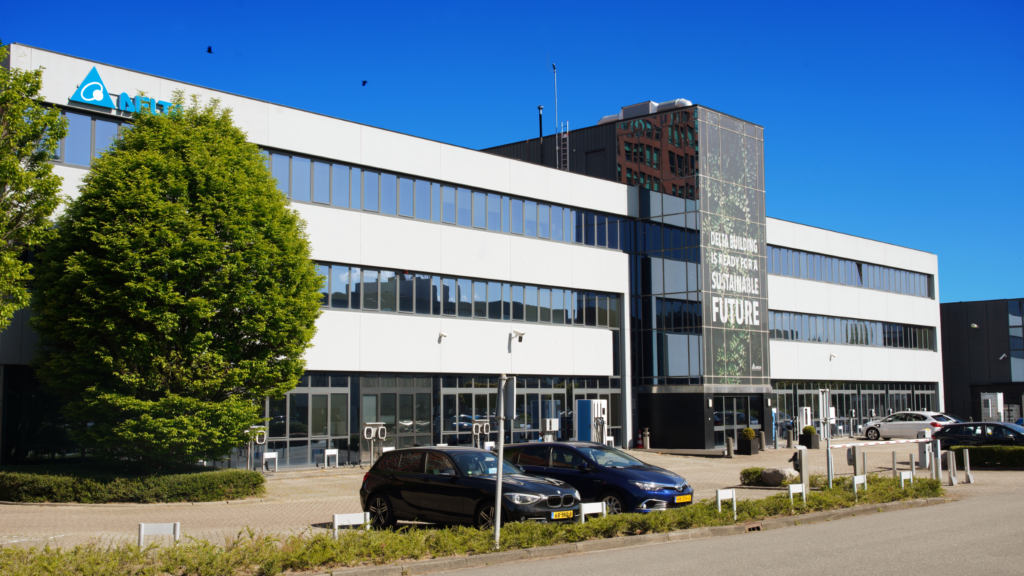
Delta EMEA’s existing regional headquarters & green building in Hoofddorp.
Leading the way in sustainability
The choice for Park 20|20 in Hoofddorp reflects a wider sustainability commitment upheld by Delta. For 25 years, the company has required that all its new buildings adopt green standards, resulting in a portfolio of 36 green buildings and 2 certificated green data centers worldwide. The EMEA region is a leader in this regard: where Delta’s global operations are aiming for 100% renewable energy use by 2030 as part of RE100, Delta EMEA is already on track to achieve this target five years ahead of schedule.
The Netherlands is at the center of these endeavors. “When we look at Park 20|20, it totally fits with what we want to do,” notes Sharma. “It’s a sustainable park talking about ‘cradle to cradle’ circularity, which totally resonates with our own mission, our own philosophy as a company.” In that vein, Delta is building its new EMEA headquarters at the park with the highest possible BREEAM Outstanding net-zero standards in mind.
Sustainability is woven into the fabric of Delta in countless more innovative ways that align with the Netherlands’ values. The company adopts internal carbon pricing, collecting funds from its offices and facilities for each kilowatt-hour of grey energy used, to be reinvested in energy efficiency projects. When engineers design a product, they consider material use and energy efficiency from the earliest stages. Delta’s smart green solutions also help customers reduce carbon emissions by improving energy efficiency in factories, buildings, power plants, EV charging infrastructure and digital infrastructure. Furthermore, Delta is well-positioned to promote environmental responsibility in the age of AI, offering smart energy solutions that can help data centers save terawatts-hours of energy while supporting the region’s digital expansion sustainably.
Cultivating talent and community across borders
Fostering sustainable communities and the next generation of innovators is a core part of Delta’s mission – so much so, that the company’s founder Bruce C.H. Cheng set up the Delta Electronics Foundation in 1990. The Foundation’s internship program has made a tangible impact bridging the Netherlands and Taiwan as the company continues to strengthen its Dutch presence.

Wim Chang
Wim Chang, CEO of Delta Foundation, shares: “Through the Foundation, Delta supports talent cultivation, climate adaptation and biodiversity enhancement, with a focus on net-zero buildings and coral restoration. Each year, five students from Taiwan are invited to the Netherlands to study climate-related topics such as water management, climate resilience and sustainable infrastructure – a program that reflects both Dutch expertise and Delta’s global vision for environmental stewardship.”
“In the words of Mr. Cheng, ‘Environmental protection is everyone’s business’ – and in the Netherlands, Delta has found a partner who lives by the same principle,” he concludes.
The Foundation’s work dovetails with larger talent recruitment initiatives. Delta collaborates closely with Dutch knowledge institutions such as Eindhoven University of Technology, Delft University of Technology and Fontys University of Applied Sciences, welcoming PhD researchers to its R&D centers and creating labs at universities themselves. The company has even brought cohorts of Dutch students to Asia to participate in its automation and technology competitions.
All this results in a robust pipeline of Dutch and global talent driving Delta’s high-tech innovation in Hoofddorp and Helmond. The company employs 270 full-time staff in the Netherlands, with those employees representing 32 nationalities. Sharma emphasizes that the welcoming, multicultural nature of Dutch society allows Delta to attract and develop a diverse workforce from around the world – a critical advantage for a regional headquarters serving more than 40 countries.
What’s next for Delta in the Netherlands? The new regional headquarters at Park 20|20 is expected for completion by 2026, marking a milestone for both the company and the Dutch ecosystem in which it is integrated. And beyond that: “It has been 25 years for us in the Netherlands, and probably we’ll be here for another 200 years. We never think about going away,” Sharma says with a smile.